Body Language, Communication, Image
Body language impacts how others perceive you. What really matters, it is not what you say, but how you say it and, most importantly, how your body conveys that message.
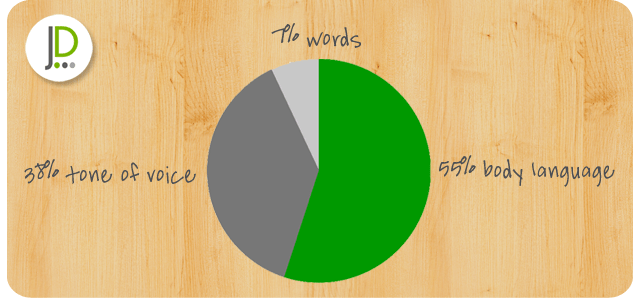
According to the research studies – words, tone of voice and body language – account differently when it comes to our perception of another person. And while we like to think that it is the content that matters, only 7% accounts for the words. The tone of your voice is more important 38%, but the real focus should be on body language which accounts for 55%. Your message is only as strong, as convincing is your body language and tone of your voice.
Your body language also reveals how you feel and think about yourself. The way you enter the boardroom or the meeting, can make a good first impression, build credibility and trust if you feel good and confident. Your posture, your walk, speed of movements, hand gestures can show your confidence and high self-esteem.

5 tips on body language to make a good first impression
Posture
Good posture makes you look confident, shows good energy and health. Remember to keep straight, roll back your shoulders and keep your chin up. Try to avoid crossing arms, while it may be simply a comfortable position but it may be taken as you are not open to the conversation.
Walk
If you walk confidently, you will be able to build instant credibility and the reaction to you will be noticeable different. Try to keep a moderate pace of your walk. If you rush, you look stressed and chaotic. But if you are very slow in your movements, it may be taken as a sign of poor confidence, insecurity or health issues.
Handshake
Give a firm, confident handshake when you meet your client or business partner. Do not try to power the other person down. Offer a straight vertical hand instead of palm down one to take control. Avoid the ‘wet noodle’ handshake that comes from timid and easily intimidated people.
Keep a comfortable space between you and the other person. If you are too far away offering a handshake you will have to lean forward and bow, if you are too close the handshake may feel uncomfortable as you are invading someones personal zone.
Eye contact
Eye contact is essential to create successful personal and business relationship, but so many of us find it difficult to do it effectively.
Keep an eye contact when shaking hand and maintain it during the meeting. Inconsistent eye contact is a sign that you are either not interested or extremely unconsidered.
You also do not want to look down when making a point, as it may look like you are uncomfortable or unsure with the statement.
Smile
Smile to show you feel comfortable and relaxed in business or social gatherings. Use smile at your business meeting to greet clients and partners, respond with smile if the conversation is to break the ice and of casual topics. But avoid smiling during serious negotiations as it may be taken for a sign of insecurity.

Communication, Image, Personal Branding
Image perception and the first impression creation process is somehow similar to the decision-making process when it comes to buying products. Economics Nobel prize winner Daniel Kahneman describes the decision making process theory in his book ‘Thinking, Fast and Slow’.
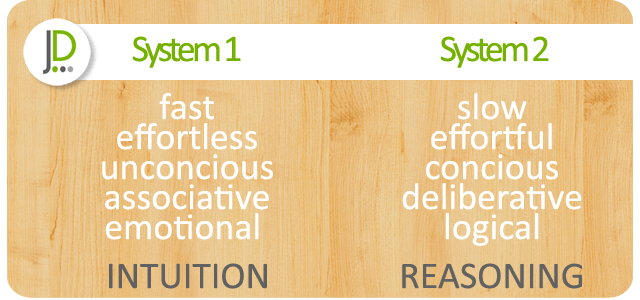
While we would like to believe that we make decisions based on a calculation of needs, price and product benefits, we actually based on our intuition and emotions. Kahneman describes two systems: System 1 is the lazy one – intuitive and emotional, the one he calls ‘a machine for jumping into conclusion’.
The conscious assessment of product features and benefits comes later and requires effort and energy. That process is a rational system 2. As Kahneman says: ‘You generally believe your impressions and act on your desires’.
This is exactly what happens when it comes to the first impression. The intuition, feelings and desires take over and we jump into conclusion. We do not have time to analyze all elements, it is the general feeling that is created instantly that impacts us the most.
Similarly to the packaging of the product and information the package contains. Customers rarely spend the time to look at the detailed information. Our brain actively seeks information that confirms its view of the world, and if the information is not available or missing, it simply fills the gaps by making up the stories, that it can access from its own memory.

When it comes to the first impression of someone, we base our opinion on very little information. But our brain needs to fill the gaps, so it draws conclusions to create a full picture. That picture is a result of a person’s previous experience, hence the created image might be different and is more a reflection of own beliefs, values, expectations than the reality.
The more information we have about the other person, the more contacts and interactions, the more detailed the picture is. Another important factor is time. With time we can actually think and assess the information. We suppress the first impression and feelings and we start rationalizing.
Intuition is your sixth sense.
It is striking, how many resemblances it has with a buying process. The less information and time we have to make a buying decision, the more likely we are to make an intuitive, emotional purchase. The cheaper the product, the more likely we are to make the quick decision. If we are buying an expensive product like a house or a car, we take our time, we analyze and compare.
Very similarly we react to people. We heavily rely on the first impression and we quickly jump to conclusions based on persons appearance and behaviour. But when it comes to important matters like choosing an employee, we run an extensive process. We gather information, conduct meetings, compare and evaluate. The first impression gives us the feel, that impacts the way we perceive the candidate. If it is positive we are more likely to interpret the other information to his or her benefit. If the impression is not positive, even the best resume will not convince us.

Communication, Image, Personal Branding
“First impression is an idea, feeling or opinion about a person formed without conscious thought or on the basis of little evidence.”
We deeply believe that it is our character and personality that counts, but the reality is that people make judgements about who we are based on first impression. It is not always the most accurate representation. And because it is formed in very short time and based on a very little information, it is always related to the other persons personal experience. Hence it is someone’s perception of you and not a real image. The accuracy of the image increases with the time. With every event or meeting with that person, we gather more information and that brings more clarity to whom he or she is.
We need to think about first impression as a snapshot, a snapshot that captures the moment and nothing else. And those few first seconds are sufficient to make a conclusion about fresh acquaintances. The first impression is created in seconds at the very first encounter – either in person or over the phone or even via email or website. Surprisingly, it has a lasting effect, as we reckon it impacts the way we perceive the person in 60%.

First impression is also about the initial feeling people have meeting you. How you make them feel is more important than what you are saying. Your appearance together with your body language and the tone of your voice create the atmosphere of the meeting. You can make others feel comfortable and relaxed or stressed and pressured. Think of how people respond to you.
From the scientific point of view, our brain is a thousand years old structure. Thanks to the increased use of our brain capability, we evolved as homo sapiens. But many reactions were inherited from our ancestors, like the one that allows our brain to recognize another human as a threat or friend in a few milliseconds. It has been trained for a thousand years to judge the situation and react very quickly based on little information.
The first impression is not the same for various people. They heavily depend on their expectations, prejudices, beliefs and stereotypes. We all have a tendency to interpret situations, events and objects in our own unique way and the distortion of opinion is the result of personal experience. In the same way we differ in interpreting another person’s appearance and behavior. It is not always a bad thing, it makes life interesting and meeting people an exciting experience.
What we need to remember is that to every person their own opinion looks real, true and solid. While it is only an illusion, their perception is their reality.

Communication
“Body language is the process of using facial expressions, gestures, gaze, tone of voice and postures in order to send and receive non-verbal messages.”
Language, as a form of communication, is quite a recent discovery. Considering the history of a mankind, and while it is still a matter of discussion, we can estimate it to few hundred thousand years. Prior to that time most of our communication was similar to those of other animals – understanding and sending nonverbal cues. Humans are the only animals on Earth that developed a complicated language structure and a vocabulary, in English language*, as an example, exceeding six digit number.
In everyday life you use usually 2500 words to communicate effectively in a wide range of social and practical situations. To be able to communicate in foreign language you need around 1000 words. And in case you do not speak a foreign language and you are in a situation you need to communicate, you manage to find a way to do so. Why? Because body language is universal. It was common to our ancestors and is part of our subconscious behavior.
Facial expressions, body movements, gestures are common to all humans in all cultures. Some gestures and reactions are inborn, and they are universal around the world. Others are typical to the culture or ethnic group, are learned by observation and some are refined with age and use.
Fear, happiness, anger are not expressed by words but by our bodies. Non verbal signs can reveal much about your feelings and meaning to others and how others reveal their feelings toward you. Being aware of your body language can help you express your feelings and emotions in a better way, can also help you to be in control of the way you show and communicate your emotions.
Unlike the spoken language, body language does not consist of vocabulary and set of grammatical rules. To understand it, you need to remember about the three rules when reading and interpreting nonverbal communication elements:
1. Read gestures in clusters – only when having big picture you can get the right information
2. Look for congruence – elements that correspond with each other, there should be a harmony between the spoken and non-spoken message
3. Read gestures in context – this one is probably the most important, always interpret behavior in its context, you simply cannot single out a gesture
*The number of words in the English language is : 1,019,729.6. This is the estimate by the Global Language Monitor for January 1, 2012 although The Second Edition of the 20-volume Oxford English Dictionary contains full entries for 171,476 words.